There's no single volume level that's right for every boat. How loud your boat speakers should be depends on your boat's size, how fast you typically run it, how much wind and engine noise you're dealing with, and where your speakers are positioned. That said, boats generally need more effective sound output than a car does, simply because music is playing in an open-air environment where sound dissipates and has to compete with wind, engine, and water noise instead of bouncing around an enclosed cabin. Two specifications matter most when figuring out how to get there: speaker sensitivity and RMS power. They're related, but they're not the same thing, and understanding the difference will save you from buying based on the wrong number.
Why Boat Speakers Need to Be Loud Enough for Open Water
Car audio and marine audio are solving different problems. Inside a car, sound is contained in a small, enclosed cabin, and the interior surfaces actually help reflect and reinforce it. A boat doesn't offer any of that. Music has to compete with wind noise, engine and mechanical noise, and the sound of water against the hull, all while dispersing into open air instead of bouncing back toward the listener.
Distance adds to the challenge. Passengers on a boat are often farther from the speakers than someone sitting in a car seat a few feet from the dash, and that gap only grows if people are standing at the bow, swimming nearby, or riding behind the boat. Boat speed matters too. A speaker system that sounds plenty loud while the boat is idling at the dock may not hold up once you're underway and wind noise picks up. That's the practical reality boat owners run into: a system that seems sufficient at rest doesn't always translate to clear sound at cruising speed.
What Does Speaker Sensitivity Mean?
Speaker sensitivity is a measurement of how efficiently a speaker converts amplifier power into audible sound output. It's commonly expressed in decibels (dB), usually measured at a standard distance with a set amount of power going into the speaker.
Think of two speakers receiving the exact same amount of power from an amplifier. If one has a higher sensitivity rating, it will generally produce more sound output than the other, simply because it's more efficient at turning that power into audible volume. A lower-sensitivity speaker isn't necessarily worse, but it typically needs more amplifier power to reach the same output level. Sensitivity is a useful number to understand, but it's one piece of a larger picture, not a standalone measure of how good a speaker will sound.
What Does dB Mean for Marine Speakers?
A dB, or decibel, rating on a speaker spec sheet tells you how efficiently that speaker produces sound output relative to the power it receives. It's a comparative measurement, not a hard ceiling on how loud a speaker can get.
Small differences in dB ratings can matter more than they appear to at first glance, since the decibel scale isn't linear. A speaker rated a few dB higher than another can produce a meaningfully greater output at the same power level. That said, sensitivity ratings are only genuinely comparable when they're measured the same way, so it's worth being cautious about comparing numbers across brands or product lines without knowing how each one was tested.
It's also worth being clear that a sensitivity rating is not the same thing as a speaker's maximum volume. It's a measure of efficiency, and it's most useful when you consider it alongside amplifier power and the rest of your system rather than as a number on its own.
What Is RMS Power and Why Does It Matter?
RMS power handling tells you how much continuous power a speaker is designed to handle during normal use. It's different from peak power, which reflects a short-term maximum a speaker can tolerate briefly, not what it can handle continuously.
RMS is generally the more useful number when you're matching speakers to an amplifier, because it reflects real-world, sustained performance rather than a brief spike. Where sensitivity tells you how efficiently a speaker turns power into output, RMS power tells you how much continuous power that speaker is built to accept in the first place. The two specs answer different questions, and neither one on its own tells you how loud a speaker will actually sound in your boat.
Speaker Sensitivity vs. RMS Power: What's the Difference?
Speaker Sensitivity What it tells you: How efficiently a speaker converts power into sound Why it matters: Helps determine how much output you can get from available amplifier power
RMS Power Handling What it tells you: How much continuous power a speaker is designed to handle Why it matters: Helps with speaker and amplifier matching
Peak Power What it tells you: A short-term maximum power figure Why it matters: Less useful for judging everyday system performance
Amplifier Power What it tells you: How much power the amplifier can provide Why it matters: Determines how much power is available to drive the speakers
Sensitivity and RMS power should be considered together rather than as competing specs. One tells you about efficiency, the other tells you about capacity, and a well-matched system needs both working in the same direction.
Why Higher-Sensitivity Speakers Can Be Useful on Boats
Open-air listening is exactly where speaker sensitivity tends to earn its keep. Wind noise, engine noise, and sound dissipating into open water all work against clarity, and listening distances on a boat are often longer than what you'd deal with in a car. A higher-sensitivity speaker can produce strong output efficiently, without necessarily requiring an oversized amplifier to get there.
That doesn't mean higher sensitivity automatically means better sound quality. Sensitivity is one factor among several, and the right balance depends on your overall system design, including your amplifier, your speaker placement, and how the boat is actually used. A highly sensitive speaker paired with a poorly matched amplifier or bad placement won't necessarily outperform a more moderate setup that's properly designed.
How Loud Should Boat Speakers Be While Cruising?
The honest answer is that boat speakers should be loud enough to stay clear and enjoyable over your boat's typical wind, engine, and water noise, without needing to run the system at its absolute limit to get there.
What that looks like in practice depends on a handful of variables: boat speed, wind conditions, engine noise, where your speakers are mounted, how far listeners are from them, your boat's size, how many speakers you have, the type of boat you're running, and simple personal preference. A system with some headroom to spare at cruising speed will generally sound clearer and less strained than one that's already maxed out just to be heard over ambient noise. There isn't a single correct dB number that applies to every boat; the goal is a system that keeps its composure once you're underway, not one built around a specific target volume.
How Speaker Sensitivity and Amplifier Power Work Together
Sensitivity and amplifier power are two sides of the same equation. A higher-sensitivity speaker can produce more output from a given amount of amplifier power, while a lower-sensitivity speaker generally needs more power from the amplifier to reach a comparable output level.
As an illustrative example only: if two speakers are rated a few dB apart in sensitivity and fed identical amplifier power, the higher-sensitivity speaker will typically sound noticeably louder. That's not a guarantee of real-world performance for any specific product, just a general illustration of how the relationship works. It's also worth noting that more amplifier power doesn't automatically make every speaker sound better. If a speaker isn't designed to handle the additional power, adding more doesn't help and can create other problems. The amplifier and speaker need to be properly matched to each other for the relationship to actually pay off.
How to Choose Marine Speakers for Your Boat
A well-matched marine audio system usually comes down to weighing these factors together rather than optimizing for just one:
- Speaker sensitivity
- RMS power handling
- Amplifier power
- Speaker impedance
- Speaker placement
- Number of speakers
- Boat size
- Typical cruising speed
- Environmental noise
- Intended listening area
None of these specs works in isolation. The best marine speaker system is the one where sensitivity, power handling, amplifier output, and placement are all pulling in the same direction for your specific boat.
Boat Speaker Volume: Why More Speakers Can Sometimes Help
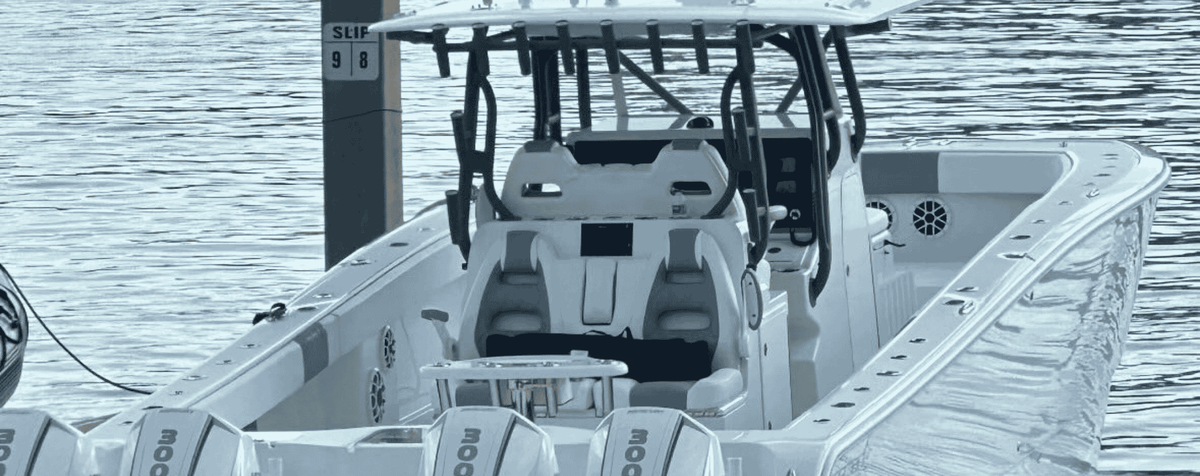
Adding speakers isn't just about raw volume. It's also a coverage strategy. Spreading sound across multiple, well-placed speakers can create more even coverage throughout a boat than relying on one or two speakers pushed to their limit.
This matters for boats where passengers are seated in different areas, since a single very loud speaker can leave some spots sounding great and others sounding thin or distant. A system built around several strategically placed speakers can deliver a more consistent listening experience across the boat, rather than treating volume as the only lever to pull. Coverage and maximum volume are related, but they're solving different problems.
Common Mistakes When Choosing Boat Speakers
A few mistakes show up often enough to call out directly:
- Choosing speakers based only on peak wattage. Peak power is a short-term figure; RMS power is the more reliable spec for everyday performance.
- Ignoring speaker sensitivity. Sensitivity affects how much real-world output you'll get from your amplifier's power.
- Assuming the highest dB rating is always the best choice. Sensitivity should be weighed alongside amplifier power and system design, not treated as a standalone score.
- Using an amplifier poorly matched to the speakers. Mismatched power and impedance can hurt performance or stress your equipment.
- Focusing only on maximum volume. Clarity and coverage matter just as much as how loud a system can get.
- Ignoring speaker placement. Where speakers sit affects how evenly sound reaches passengers.
- Forgetting about wind and engine noise. A system that sounds fine at the dock may struggle once you're underway.
- Assuming a stationary test tells the whole story. Performance at cruising speed is what actually matters day to day.
- Installing too few speakers for the boat's size. Coverage often benefits more from thoughtful speaker count and placement than from one louder speaker.
A Simple Checklist for Choosing the Right Boat Speakers
- Check the speaker sensitivity rating
- Review RMS power handling
- Match the amplifier appropriately
- Check speaker impedance
- Consider the boat's size
- Consider how fast the boat typically travels
- Account for wind and engine noise
- Think about speaker placement
- Consider how many speakers are needed for even coverage
- Leave enough system headroom for comfortable listening at cruising speed
How Loud Should Boat Speakers Be? The Bottom Line
There's no universal volume level that works for every boat. Effective marine audio performance comes down to speaker sensitivity, RMS power handling, amplifier power, speaker placement, the number of speakers you're running, your boat's size, listening distance, environmental noise, and boat speed, all working together.
Higher-sensitivity speakers can be genuinely useful in open-air environments because they produce strong output efficiently, but sensitivity is only one part of the equation. It needs to be considered alongside RMS power and the rest of your system design, not evaluated on its own.
Final Summary: Choosing the Right Volume and Speaker Specifications
Figuring out how loud your boat speakers should be isn't about chasing the highest wattage or dB number you can find. A few things matter more:
- Sensitivity: Indicates how efficiently a speaker converts amplifier power into sound output.
- RMS power: Indicates how much continuous power a speaker is designed to handle.
- Amplifier matching: Ensures your speakers receive appropriate power for their design.
- Open-air environment: Boats have to overcome wind, engine, and water noise that a car cabin simply doesn't deal with.
- System design: Speaker placement, speaker count, boat size, and listening distance all shape the final result.
The goal isn't making your boat speakers as loud as possible. It's building a system with enough output and headroom to stay clear and enjoyable, even once you're moving.
Get More From Your Marine Audio System With Wet Sounds
Getting the volume right on a boat comes down to how sensitivity, RMS power, and amplifier matching work together as a system, not just picking the loudest speaker on the shelf, and that's the approach we take with our marine audio solutions. We build our systems for boat owners who want clear, powerful sound that actually holds up once the engine's running and the wind picks up.
If you're ready to put together a system that's properly matched for your boat, we invite you to explore our marine speakers and audio solutions and find the setup that fits how you spend time on the water.
Frequently Asked Questions
How loud should boat speakers be?
There's no universal volume level for every boat. Your system should be capable of producing clear, enjoyable sound that stays audible over wind, engine, and water noise without needing to run at maximum output continuously. The right level depends on your boat's size, speed, speaker placement, and how many speakers you're running.
What is a good sensitivity rating for marine speakers?
There isn't one universal dB number that's ideal for every boat. Higher-sensitivity speakers tend to be useful in open-air marine environments because they produce strong output more efficiently, but sensitivity should always be evaluated alongside amplifier power, RMS power handling, and your overall system design rather than on its own.
How much RMS power do boat speakers need?
The RMS power a boat speaker needs depends on the speaker's design, its sensitivity rating, your amplifier's output, your boat's size, and your typical listening environment. Higher RMS power handling doesn't automatically mean a speaker will sound louder; it simply indicates how much continuous power that speaker is built to accept.
Does a higher-powered amplifier make boat speakers louder?
Additional amplifier power can increase potential output, but only when the speaker is designed to handle it. More power isn't automatically better. What matters is matching your amplifier's output to your speaker's RMS power handling and impedance, so the system works together rather than working against itself.
Why do boat speakers need to be louder than car speakers?
Boats are open-air environments where sound dissipates and competes with wind, engine, and water noise instead of staying contained. A car cabin is enclosed, so its interior surfaces help contain and reflect sound back toward the listener. That difference is why marine speakers often need more effective output to sound just as clear.