Tower Speakers vs. Coaxial Speakers: Which Is Right for Your Boat?
If you're shopping for a new boat sound system, you've probably run into this question more than once: should you go with tower speakers or coaxial speakers? The honest answer is that it depends on your boat and how you actually use it. Tower speakers are generally the better option for projecting sound toward people behind the boat, especially during wakeboarding and wake surfing, while coaxial marine speakers tend to do a better job delivering sound coverage to passengers who are on board. Neither one is a universal upgrade over the other. They're built to solve different listening problems, and once you understand what those problems are, the right choice usually becomes obvious.
Tower Speakers vs. Coaxial Speakers: What's the Difference?
The core difference between these two speaker types comes down to where they're mounted and who they're designed to reach. Coaxial speakers are typically installed low in the boat, often under the gunwale, and they're built to fill the interior of the boat with sound for the people sitting in it. Tower speakers are mounted up high, usually on a wakeboard tower, and they're designed to send sound outward and behind the boat toward riders in the water.
This is really a distinction between sound projection and sound coverage. Sound projection refers to how far and how directionally a speaker can send audio toward a specific area, like the wake behind a boat. Sound coverage refers to how evenly a speaker (or set of speakers) fills a defined space with sound, like the cockpit of a pontoon. Tower speakers are built with projection in mind. Coaxial speakers are built with coverage in mind. Once you know which one your boat actually needs, the decision gets a lot simpler.
Distance from the listener matters too. If most of your listeners are sitting a few feet away from the speakers, coverage is what counts. If your listeners are riders 50 to 75 feet behind the boat, projection is what counts.
What Are Marine Tower Speakers?
Marine tower speakers are speakers mounted on a wakeboard or wake surf tower, positioned above the boat rather than inside it. That elevated placement is intentional. Mounting speakers higher up gives sound a clearer, more direct path outward and behind the boat, without the hull, seating, or passengers getting in the way.
This makes tower speakers a natural fit for watersports-focused audio systems. Wakeboarders and wake surfers are often 50 feet or more behind the boat, and they need music that actually reaches them clearly over engine noise and water spray. Tower speakers are built to project sound toward that zone rather than simply filling the boat itself.
They're also useful any time your listeners are farther from the boat, not just during watersports. If your boat regularly has people swimming nearby, floating off the back, or relaxing at a distance, the directional throw of tower speakers can carry sound to areas that under-gunwale speakers weren't designed to reach.
What Are Coaxial Marine Speakers?
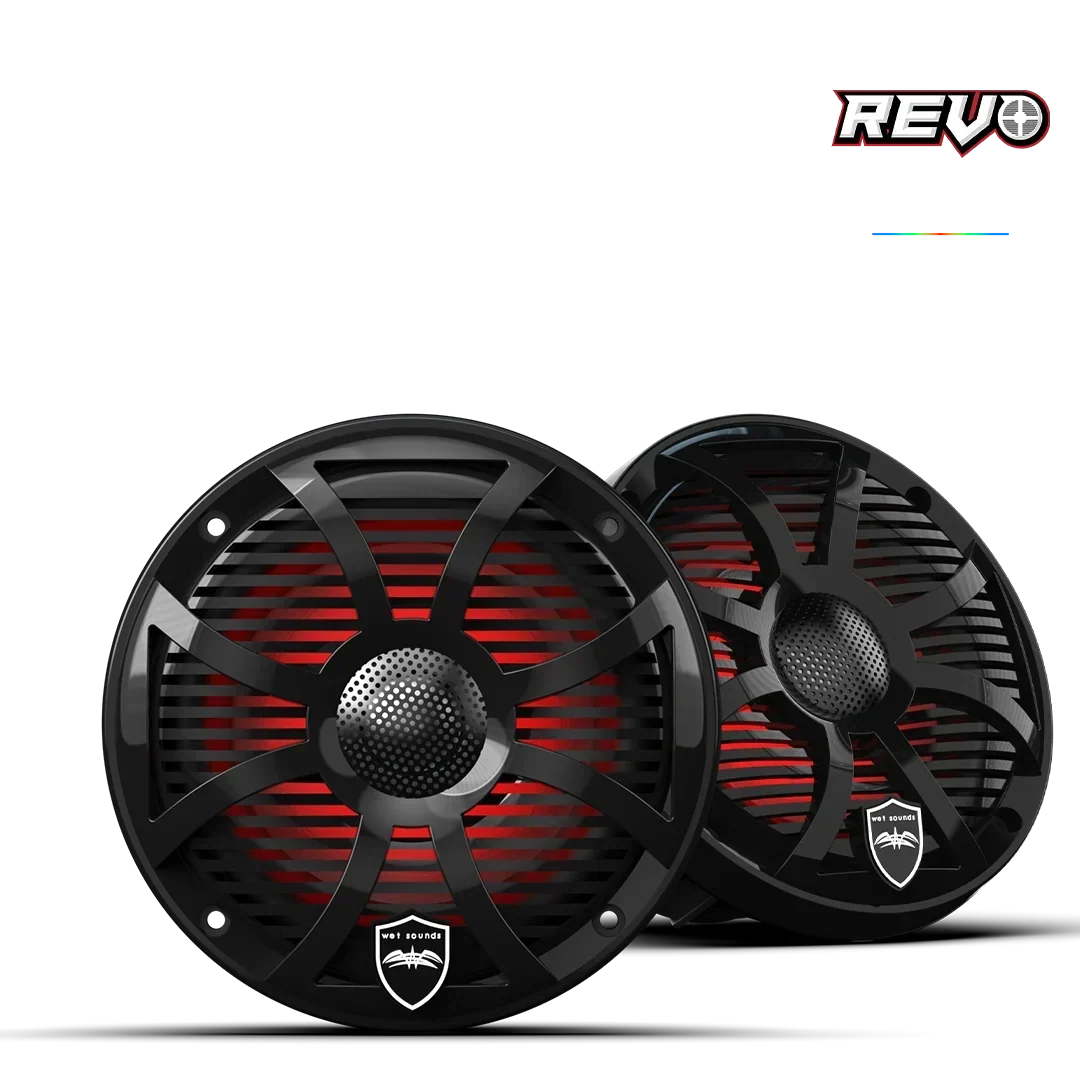
Coaxial marine speakers combine multiple speaker elements, like a woofer and tweeter, into a single unit that produces full-range sound from one location. They're typically installed under the gunwale, in the helm area, or at other points around the boat's interior, rather than mounted up high.
Because they're built for coverage rather than long-range projection, coaxial speakers work well when the goal is filling a boat's interior evenly. A pontoon with speakers positioned along both sides, or a cruiser with speakers near the helm and seating areas, can create a consistent listening experience no matter where passengers are sitting.
This is why coaxial speakers are so common in pontoons, cruisers, and general-purpose boats. These boats are usually built around onboard seating and entertaining rather than watersports, so the priority is even sound throughout the boat rather than projecting audio toward the wake. Using multiple coaxial speakers spread across different zones of the boat, rather than relying on just one or two, is typically what creates that more balanced coverage.
Tower Speakers vs. Coaxial Speakers: Key Differences
Sound projection Tower speakers: Strong, directional, aimed outward/behind the boat Coaxial speakers: Limited; not designed for long-range throw
Sound coverage Tower speakers: Focused on a specific zone (behind/outside the boat) Coaxial speakers: Broad, even coverage across the boat's interior
Ideal placement Tower speakers: Mounted high on a wakeboard/wake surf tower Coaxial speakers: Under the gunwale or other interior mounting points
Best boat types Tower speakers: Wakeboard boats, wake surf boats, some open bow boats Coaxial speakers: Pontoons, cruisers, general recreational boats
Best use cases Tower speakers: Watersports, riders in the water, listeners at a distance Coaxial speakers: Passengers seated on board, entertaining, cruising
Watersports performance Tower speakers: Strong, purpose-built for this Coaxial speakers: Not designed for this use case
Installation considerations Tower speakers: Requires a tower or elevated mounting point Coaxial speakers: Flexible mounting throughout the boat
Listener position Tower speakers: Outside or behind the boat Coaxial speakers: Inside or around the boat
Overall listening experience Tower speakers: Directional and far-reaching Coaxial speakers: Even and immersive for onboard passengers
Which Boats Are Best for Marine Tower Speakers?
Tower speakers tend to make the most sense on boats where watersports are a regular part of how the boat gets used. Wakeboard boats and wake surf boats are the clearest examples, since riders are consistently positioned behind the boat and need sound that can reach them over wind, engine, and water noise.
Open bow boats can also benefit from tower speakers, though it depends more on layout and how the boat is actually used. If passengers spend time near the bow, swimming nearby, or otherwise farther from the boat's interior, the added projection from tower speakers can help sound reach areas that interior speakers weren't built for.
The common thread across these boats isn't the hull style. It's that the primary listening area extends outside or behind the boat rather than staying contained within it. When that's true, tower speakers are usually the more effective choice.
Which Boats Are Best for Coaxial Marine Speakers?
Coaxial speakers tend to be the more practical choice for boats where passengers are primarily seated on board rather than out in the water. Pontoons and cruisers are the most common examples, since these boats are typically built around entertaining, relaxing, and spending time in the cockpit or seating areas.
For these boats, under-gunwale placement and distributed speaker locations do a lot of the work. Spreading speakers around the boat rather than concentrating them in one spot helps create a more consistent listening experience, so passengers at the bow aren't left with noticeably weaker sound than passengers near the helm.
General recreational boating fits into this category too. If your time on the water is mostly spent cruising, anchoring, and socializing on board, coaxial speakers are typically better suited to providing the kind of audio coverage that supports that experience.
Can You Use Tower Speakers and Coaxial Speakers Together?
Yes, and for a lot of boat owners, this combination is the most complete solution. Rather than treating tower speakers and coaxial speakers as competing options, many marine audio systems are designed to use both, with each type handling the job it's best suited for.
In a combined setup, coaxial speakers installed under the gunwale or around the interior provide steady sound coverage for passengers on board. Tower speakers, mounted higher up, add focused sound projection toward riders behind the boat during watersports. The two systems work in parallel rather than overlapping, since they're covering different listening zones.
This kind of setup tends to make the most sense for boat owners whose time on the water isn't limited to just one activity. If your boat gets used for cruising with friends one weekend and wakeboarding the next, combining tower and coaxial speakers means your audio system doesn't have to compromise for either use case.
How to Choose the Right Speakers for Your Boat
A few questions can help narrow down the right setup for your boat:
-
What type of boat do you have? Wakeboard and wake surf boats lean toward tower speakers; pontoons and cruisers lean toward coaxial.
-
How is the boat actually used? Watersports-heavy use favors projection; onboard entertaining favors coverage.
-
Where do listeners spend most of their time? Behind or outside the boat points to tower speakers; seated on board points to coaxial.
-
Do you need sound to project toward a specific area? If yes, tower speakers are built for that.
-
Do you need sound to fill the boat evenly? If yes, coaxial speakers are built for that.
-
What mounting locations are available? A tower opens up projection options; gunwale space supports distributed coverage.
-
Is watersports or cruising the priority? This often settles the decision on its own.
-
Are you designing a full system rather than a single speaker type? If so, combining both may be worth considering.
Working through these questions in order usually points pretty clearly toward tower speakers, coaxial speakers, or a combination of the two.
Tower Speakers vs. Coaxial Speakers: Which One Should You Choose?
If watersports and sound projection toward riders are the priority, tower speakers are generally the better fit. If onboard sound coverage for passengers is the priority, coaxial marine speakers are generally the better fit. If your boat needs to do both, combining the two speaker types can create a more complete marine audio system.
Final Summary: Which Marine Speakers Are Right for Your Boat?
The choice between marine tower speakers and coaxial marine speakers comes down to boat type, how the boat is used, and where listeners spend most of their time.
-
Wakeboard and wake surf boats: Tower speakers are often the better choice for projecting sound toward riders behind the boat.
-
Open bow boats: Tower speakers can help when additional projection is desired, depending on layout and use.
-
Pontoons and cruisers: Coaxial marine speakers are often the better fit for consistent onboard sound coverage.
-
For maximum flexibility: Combining tower and coaxial speakers creates a complete system that serves both passengers and riders.
There's no single best speaker type for every boat. The right setup is the one that matches how you actually spend time on the water.
Upgrade Your Boat's Audio With Wet Sounds
Choosing the right speaker setup starts with understanding how and where you actually use your boat. Whether you're chasing the perfect wake surf soundtrack or want even sound coverage for a pontoon full of passengers, we build our marine audio products around the way boat owners actually spend their time on the water.
If you're still weighing tower speakers against coaxial speakers, we invite you to explore our marine speaker options and find the setup that fits your boat. From wakeboard towers to under-gunwale installations, we're here to help you put together a system that sounds right for the way you ride, cruise, and entertain.
Frequently Asked Questions
Are tower speakers better than coaxial speakers for boats?
Neither is universally better; the right choice depends on how you use your boat. Tower speakers vs coaxial speakers really comes down to projection versus coverage: tower speakers are generally better for projecting sound toward listeners outside or behind the boat, while coaxial marine speakers are often better suited to providing sound coverage for passengers seated on board.
Do I need tower speakers for a wakeboard or wake surf boat?
Tower speakers aren't strictly required, but they're often a strong choice for wakeboard and wake surf boats. Because riders are typically well behind the boat, marine tower speakers mounted up high can project sound toward them more effectively than speakers installed low in the boat's interior, which are built more for onboard coverage than long-range throw.
Are coaxial marine speakers a good choice for pontoon boats and cruisers?
Yes, coaxial marine speakers are often well suited to pontoons and cruisers. These boats are typically built around onboard seating and entertaining, so even sound coverage across the boat's interior matters more than projecting sound toward the water. Coaxial speakers installed under the gunwale or around seating areas help deliver that consistent, boat-wide listening experience.
Where should marine speakers be placed on a boat?
Placement depends on your boat's layout and where listeners spend their time. Coaxial speakers are commonly installed under the gunwale or around passenger seating to provide even coverage inside the boat. Tower speakers are mounted higher, usually on a wakeboard tower, to project sound outward and behind the boat toward riders or listeners farther away.
Can I use marine tower speakers and coaxial speakers together?
Yes, many boat owners combine both speaker types in the same marine audio system. Coaxial speakers handle onboard sound coverage for passengers, while tower speakers add focused sound projection toward riders or listeners behind the boat. Together, they create a more complete system that serves both watersports and onboard listening needs.